
I often sit down with owners of stunning boutique hotels or high-end clinics in Thong Lo, and their question is always the same: “Why isn’t my expensive, beautiful website driving calls?” The brutal truth for Bangkok customers in 2026 is that complexity kills conversions. Here is the surprising strategy for local websites: less is much, much more.
Is Your Website Over-Complicated?
I often sit down with new clients, owners of beautiful dental clinics in Thong Lo or stunning boutique hotels near the river, and they show me these complex websites. They’re filled with flashy animations, long articles about their company history, and dozens of pages. They’ve invested a lot of money, but the phone isn’t ringing any more than it used to. They’re confused because a competitor with a simple, almost ‘boring’ website is showing up higher on Google Maps.

Here’s the truth for 2026: when it comes to your website, simple is not just better, it’s more profitable. Customers searching for local services are not looking for a novel. They have an immediate need and want quick answers. Your website’s main job is to answer three questions in under five seconds: What do you do? Where are you located? And how can I book or contact you? Anything else is often just noise that gets in the way of a new customer walking through your door.
The New Rules for a High-Performing Local Website
For years, the advice was to add more content, more pages, and more keywords. That era is over. Today, Google’s systems are smarter, and they prioritize user experience above all else. A customer landing on your website should feel relief, not confusion. Your homepage should act like a clear and helpful receptionist, not a pushy salesperson.
Take a hard look at your homepage. Does it clearly state what you are and where you are in the main headline (e.g., “Ploenchit Skin Care Clinic”)? Are your core services listed in a simple bulleted list? Is your phone number clickable on a mobile phone, and is your address linked directly to Google Maps? If a potential customer has to hunt for this information, they will simply click the ‘back’ button and give their business to your competitor. This is the simple, focused approach that is winning right now.
Reality Check: Google’s AI is Your Newest Customer
It’s important to understand that it’s not just impatient humans you need to impress. Since the big algorithm updates in 2025, Google relies heavily on AI to understand and rank websites. This AI behaves like a person with zero patience; it scans your site for clarity and purpose. It rewards websites that are easy to understand.
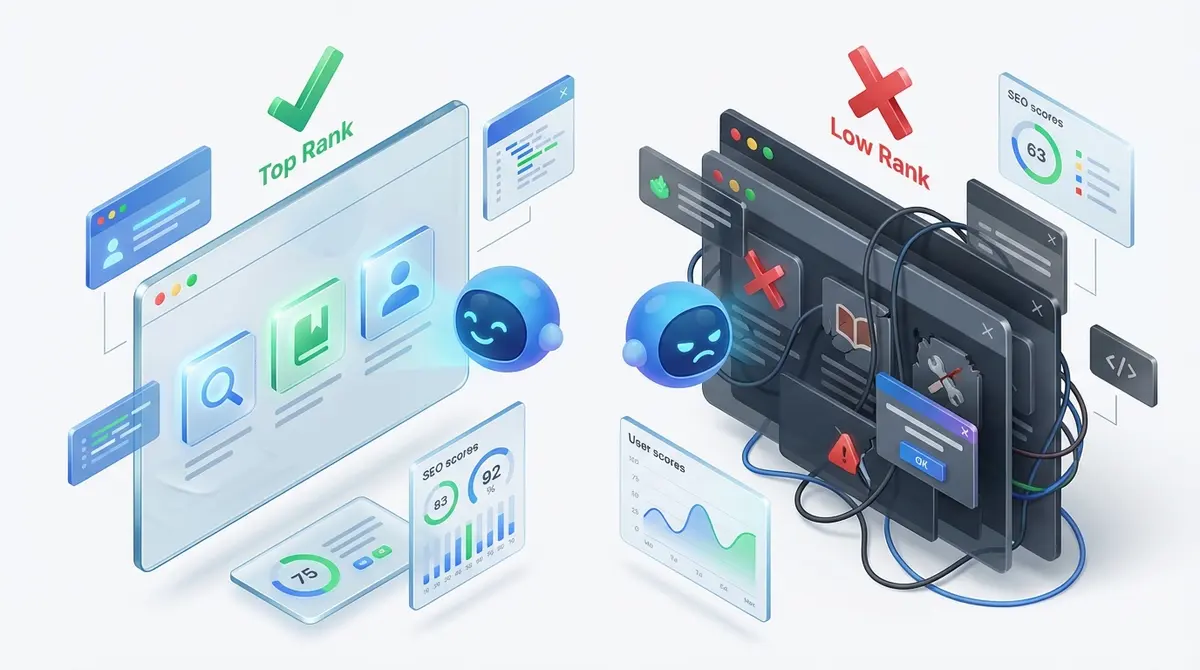
According to Google’s own direction, their systems now favor clean design, fast loading speeds, and structured content. This means clear headings, short paragraphs, and direct answers are critical. A cluttered, slow-loading site isn’t just frustrating for users; it’s a direct signal to Google that your website is not helpful, which will cause your rankings to drop.
The Trap: Confusing ‘Content’ with ‘Clutter’
The biggest myth I see business owners fall for is that “more content is always better.” They get talked into adding blog posts about topics their customers don’t care about or stuffing paragraphs with keywords until the text is unreadable. This is a trap. This kind of ‘over-optimization’ does more harm than good. It slows down your website and, more importantly, it buries the essential information your real customers are looking for.
Think of it this way: your website’s homepage is the front door to your business. Your Google Maps Listing is the big sign on the street that gets people to that door. If the sign is clear but the door is locked or confusing to open, you lose the customer. A simple, focused homepage supports your Google Maps Listing; it doesn’t try to do its job. The heavy lifting for getting discovered locally happens on Google Maps, fueled by your location, services, and reviews.
The Struggle: Keeping It All Fresh
I recently spoke with the owner of a fantastic law firm in Silom. He had a great, simple website but his Google Maps Listing had outdated photos and listed services he no longer prioritized. New clients were getting confused, and his rankings were slowly slipping because his online presence felt neglected.
The problem for a busy owner is that your Google Maps Listing isn’t a ‘set it and forget it’ tool. According to Google’s official guidelines, it needs to be actively managed with fresh photos, updated services, and prompt review responses to stay competitive. Manually keeping up with this, on top of running your business, is a constant operational headache. This is the kind of work that gets pushed to the bottom of the to-do list, costing you customers without you even realizing it. This is precisely the challenge we designed our tools to handle. With OnEveryMap, we help you keep that crucial Google listing consistently fresh and accurate, ensuring the customers who find your great website are getting the right information at the right time.