Get More Customers
AI is Here. Will It Send Customers to You or Your Competitor?
Aiyah R
A good friend, who runs a boutique hotel in Chiang Mai, recently vented her frustration. She saw bookings dip, wondering why their beautiful property wasn’t appearing for guests asking their phone for ’boutique hotels with a rooftop pool.’ The truth is, AI recommends businesses it truly understands. Let’s explore how to make your business crystal clear, so AI sends customers directly to you.
Your New Customer Isn’t Searching, They’re Asking
It’s a Thursday evening in Sukhumvit. A tourist asks their phone, “Find me a clinic for teeth whitening near Nana that is open now and has good reviews.” An AI assistant answers, giving them one, maybe two options. If your clinic isn’t one of them, you just lost a customer you never knew you had.
This isn’t science fiction; it’s happening right now. The way customers find you is changing from typing keywords into a search bar to having a conversation with an AI. For your business to be recommended, Google’s AI needs to understand what you offer with perfect clarity. This means your online business information must be more accurate and detailed than ever before.
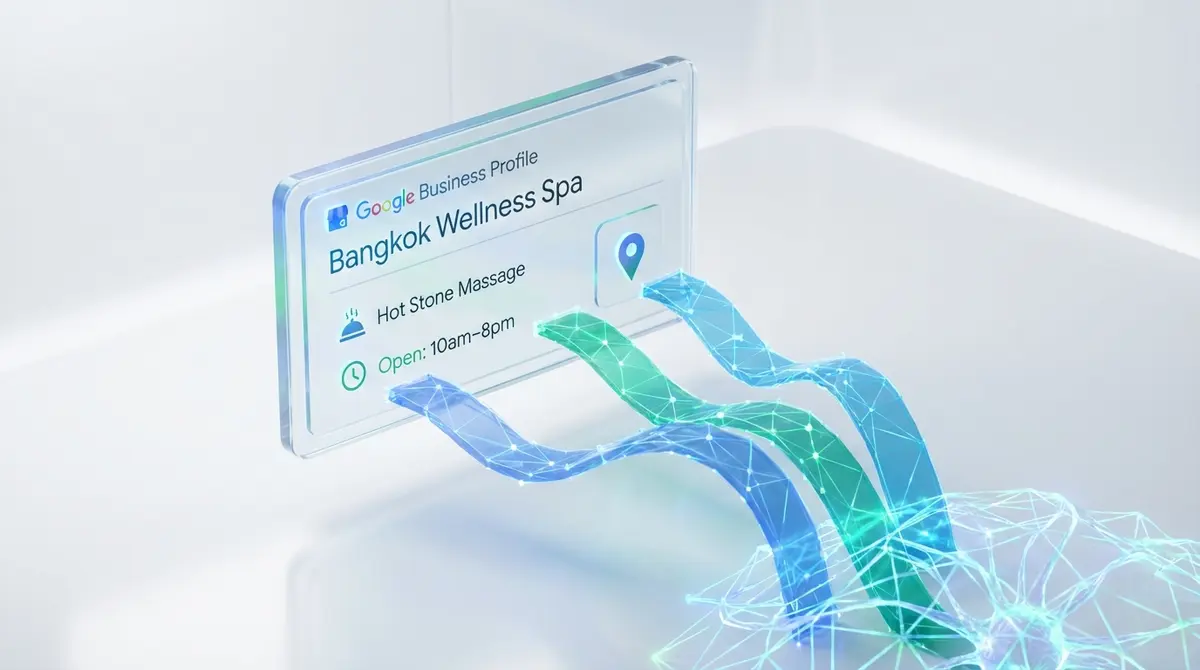
The Meat: How to ‘Teach’ AI About Your Business
The single most important thing you can do is treat your Google Maps listing (officially called a Google Business Profile) as the ultimate source of truth for your business. It is no longer just a map pin; it’s the primary data source for AI assistants. You need to be ruthlessly detailed.
- Go Beyond Categories: Don’t just list yourself as a “Spa.” Add every single service you offer: “Hot Stone Massage,” “Aromatherapy Facial,” “Thai Herbal Compress,” “Manicure & Pedicure.” An AI can’t recommend you for a service you haven’t explicitly listed.
- Use Specific Attributes: Google allows you to add details like “Wheelchair Accessible Entrance,” “Free Wi-Fi,” or “Accepts Credit Cards.” Check every box that applies. An AI uses these as filters. If a user asks for a restaurant with outdoor seating and you haven’t ticked that box, you are invisible for that request.
- Keep Hours Hyper-Accurate: This includes holidays and special events. If an AI sends a customer to your shop and finds you closed when your listing said you were open, that’s a bad experience that Google works hard to avoid. They will be less likely to trust your information and recommend you in the future.
Reality Check: This is Not Just a Theory
Top marketing experts are already deep into testing how AI uses our business data. This isn’t some far-off future concept; the technology is already being deployed.
Just recently, at a major tech conference in the United States called TechSEOConnect 2025, a marketing executive from a large food platform, Jori Ford, demonstrated exactly how AI systems are trying to use structured business data, like your menu items or service lists, to give better, more direct answers to users. The key takeaway is that AIs prefer clean, well-organized data, and they often pull it from official listings before they try to ‘read’ your website.
The Trap: Believing Your Website is Enough
The most common mistake I see business owners make is thinking, “All the information is on my website, so Google can find it.” This used to be true, but it’s now dangerously outdated advice. AI assistants are built for speed and efficiency; they don’t want to browse your beautifully designed ‘About Us’ page to figure out if you offer valet parking.
They look for data in predictable, structured places first, with your Google Business Profile being the most important one. Relying on your website alone means you’re forcing the AI to do extra work, and it may get the details wrong or, more likely, simply choose a competitor whose information is easier to understand.

The Struggle: Keeping It All Straight
I was talking with the owner of a premium car care center in Thonglor. He was frustrated because a customer called, angry that he was quoted the wrong price for a ceramic coating by an AI assistant, a price that was outdated on an old directory website but correct on his main company site.
This is the core problem: your business information lives in many places online, and inconsistencies confuse both customers and AI. Manually keeping your hours, services, and photos updated across Google, Facebook, and other directories is a constant, time-consuming battle. It’s the kind of administrative work that takes you away from running your actual business.
The Solution: Control Your Data from One Place
To ensure AI assistants get the right information every time, your business data must be consistent everywhere. You can do this manually by logging into every platform one by one each time you change a price or update your holiday hours. It’s tedious, but necessary.
This is the exact operational headache we built OnEveryMap to solve. Instead of you updating ten different websites, our platform lets you manage your core business information from a single dashboard. You update your services or hours once, and OnEveryMap pushes that correct information across the most important online platforms. This ensures that whenever an AI, or a human customer, looks for you, they find the right answer, right away.