Learn the Basics
Google Business Profile for Franchises: The Complete Thai Guide
Jan Rohweder · Founder of OnEveryMap · CEO & Founder of Marketing Bear
Insights from Jan, founder of OnEveryMap and CEO & founder of Marketing Bear.
Most of what I know about franchise visibility, I learned the hard way, by running the location-data and visibility work for Michelin's retail network across Thailand and Southeast Asia over several years: its tyre and auto-service stores (TyrePlus and other Michelin tyre retailers), where drivers buy tyres and get their cars serviced. Hundreds of locations, dozens of owners, one brand that customers expected to look and feel the same everywhere. That experience taught me one uncomfortable truth that I want to open this guide with: for a multi-location brand, a Google Business Profile is not a checkbox. It's a living asset, and when you neglect it, it quietly costs you real business.
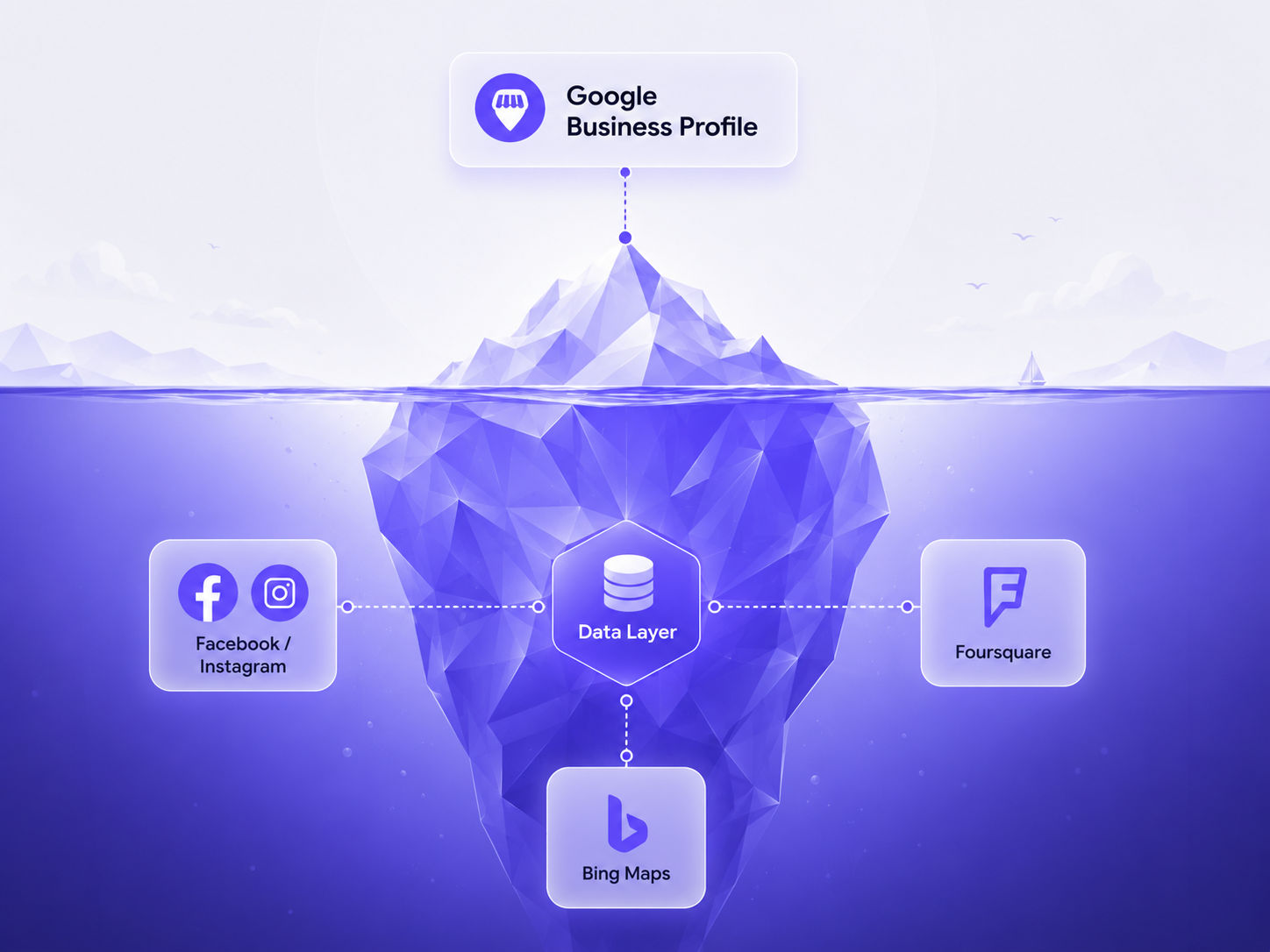
This is a practical, Thailand-focused guide to Google Business Profile management for franchises and multi-location brands. It's long, because the topic is bigger than most operators think. If you take one idea away, make it this: your Google Business Profile is the tip of the iceberg.
The "set it up once" mistake and its hidden cost
It's genuinely hard to name one mistake that every multi-location brand makes. But there's a mindset I see again and again: brands still treat Google Business Profile as something you set up once, so people can navigate to the store, and then forget.
If you only set it up once, yes, when a customer searches for the exact name of your location, you'll probably show up. But that immediately raises questions. If there's no recent information on the profile, are customers actually trusting it? Are you keeping operating hours, addresses and phone numbers current as they change across the network? For most brands, the profile is just one of the boxes they tick to "get started," and they never realise the hidden potential in making sure every location is visible when people search for something related to what they sell, not just the brand name.
And "search" here doesn't only mean Google Search and Google Maps anymore. It means AI tools, too.
That realisation is usually eye-opening for the brands I talk to, because there's a hidden cost buried in the neglect: the business you lose without ever seeing it. Nobody sends you an email to say they couldn't find your nearest branch, or that the hours looked wrong so they went to a competitor. The loss is silent. That's exactly what makes it dangerous.
In our own 2026 research into Thai franchise brands, the neglect was visible in the data. 124 of them were effectively invisible when we checked their Google Maps footprint, and 2,151 individual locations had no website link attached to their profile (measured July 2026). Those are brands and branches leaving discovery (and money) on the table.

What is Google Business Profile management for a franchise?
Google Business Profile management is the ongoing work of keeping every one of your locations accurate, complete, consistent and active across Google Search and Google Maps, and, increasingly, keeping that same information consistent everywhere else the internet reads about your business.
For a single café, that's a light job. For a franchise with 40, 80 or 400 locations, it's an operations discipline. It covers:
- Claiming and verifying every location, and controlling who has access.
- Getting the core data right (name, address, phone, hours, categories) and keeping it right as branches move, change hours, or change owners.
- Categories and attributes, which strongly shape which searches you appear for.
- Photos, posts and Q&A, kept fresh so the profile looks alive and trustworthy.
- Reviews: collecting them, and responding to them.
- Consistency across the whole network, so every branch reads as the same brand.
You'll hear this work called several different things: local SEO, local performance optimization, local visibility optimization, digital footprint optimization. The label doesn't matter. In the end it's all about the same goal: getting your listings visible and trusted so the right customer finds the right branch.
Which franchises win or lose the most on Google Business Profile
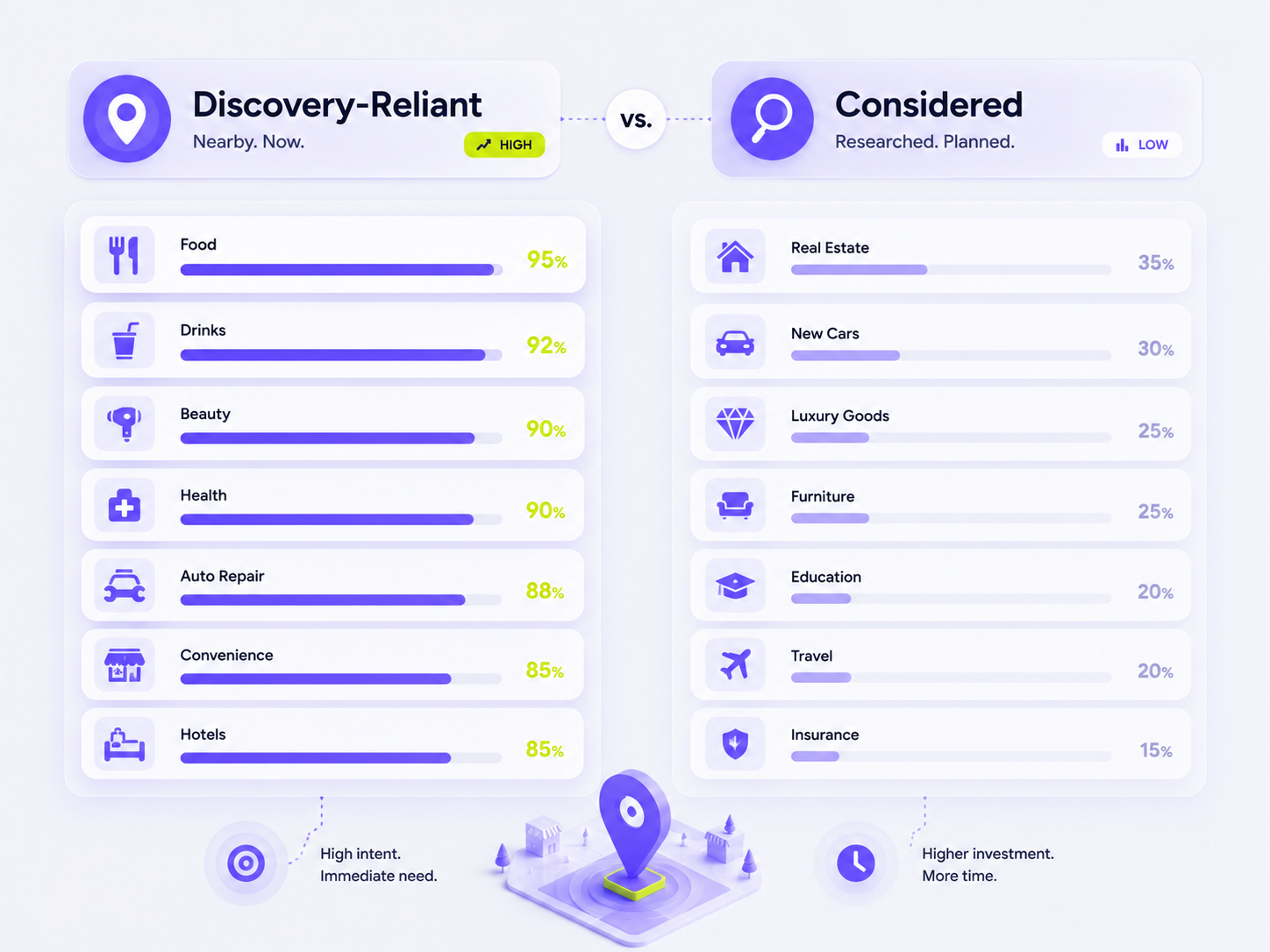
This work matters most for businesses that rely on being discovered in the moment.
Think about anything that doesn't involve a long, considered decision. Low-ticket, low-consideration categories: food and drink, clothes, health-related items you don't want to wait for. Anything to do with your car when something breaks down. A quick getaway or a hotel stay. Any situation where a customer doesn't want to spend weeks or months researching the "right" option: they want a good option, nearby, now.
That's exactly where you need your location to pop up at the top when someone searches for something related to you. If a customer's engine light comes on in a province they don't know, they're not researching for a week. They're opening Google Maps and picking a nearby garage they can trust in the next ten minutes. If your branch isn't there, or looks abandoned, you weren't in the running.
For high-consideration, long-cycle purchases the pressure is lower. But for the categories most Thai franchises live in (food, drinks, beauty, health, auto, convenience, quick stays), discovery is the game.
Google Business Profile is the tip of the iceberg
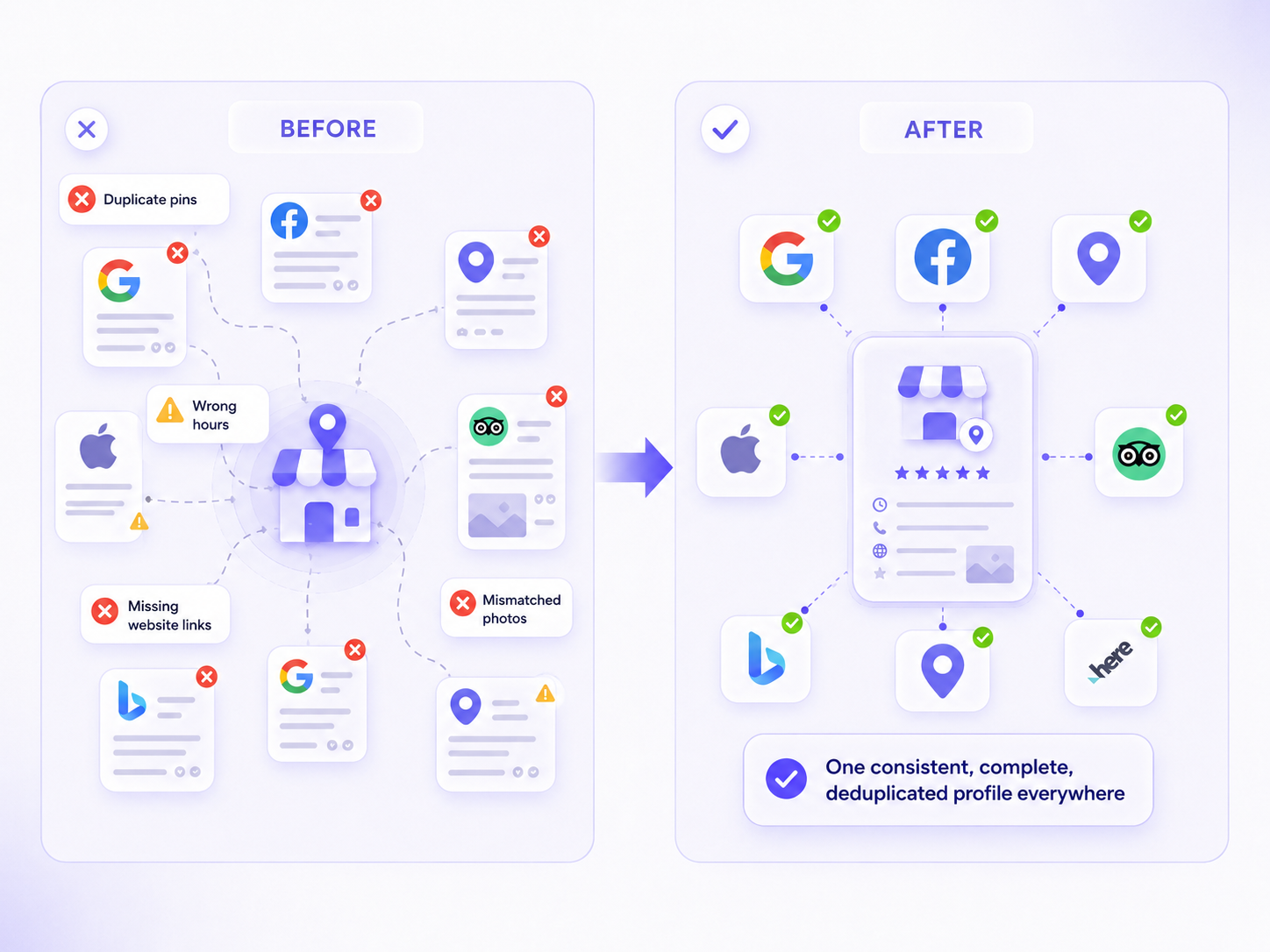
Here's the part most brands miss. Your Google Business Profile is not a closed system. It's the most visible peak of a much larger mass of data about your locations that lives all over the internet, and that wider mass is what really decides how confidently the world (including Google itself) can recommend you.
Under the surface sit:
- Facebook and Instagram location and business information.
- Data aggregators: the companies that collect and resell business-location data. Foursquare is the clearest example. Almost nobody uses Foursquare as an app anymore, but it reinvented itself as a data aggregator for business locations, and that data gets sold on to the companies building AI.
- Bing Maps. Bing isn't the most popular map in Thailand, but it's used as a source to verify data, and it feeds Microsoft Copilot, which more and more people encounter simply because it auto-starts with Windows.
When the same accurate information about a location appears consistently across all of these, something useful happens: even Google trusts its own data more. If Google finds the same name, address, hours and category confirmed across other directories, that consistency actually lifts your visibility on Google itself. Inconsistency does the opposite: it introduces doubt.
So the profile is where you look. The iceberg underneath is where you win.
Does Google Business Profile decide whether AI tools recommend your locations?
Increasingly, yes, and this is the single most important shift happening in local search right now.
AI tools surface the information they're most confident about. When someone asks an AI assistant for, say, the best place for a certain type of food in Bangkok, it doesn't return everything. It returns a short list of options it feels most confident will give the person a good experience.
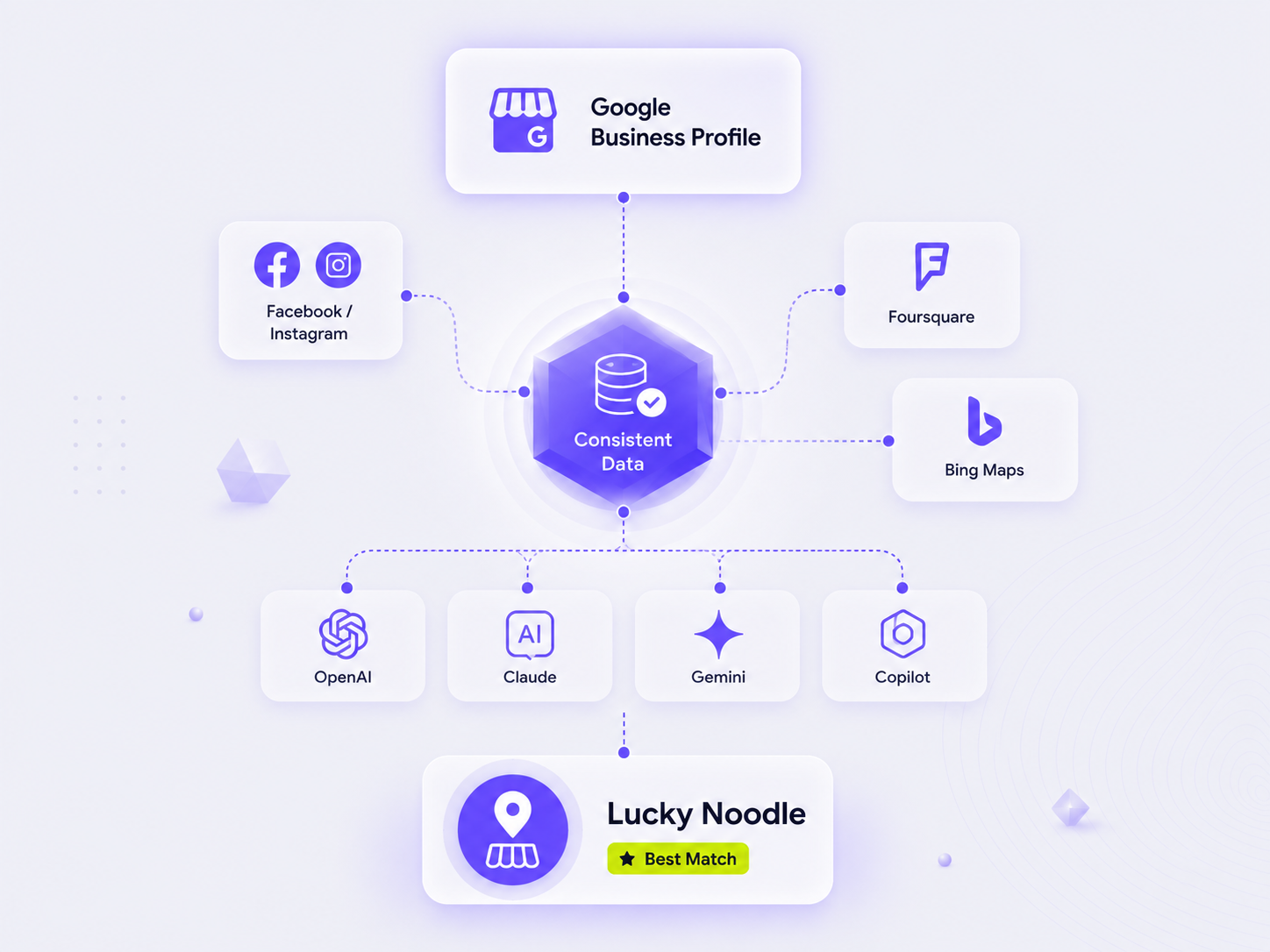
Where does that confidence come from? Partly from your Google Business Profile: what customers see on Google Maps, how they've interacted with the profile, and what the reviews say. But also from being present, and consistent, across all the other directories that feed AI systems, including those data aggregators. If a customer is looking for a shop with a specific expertise, or a restaurant with a specific dish, the AI wants to be sure that service or dish is genuinely available before it recommends you. The only way it can be sure is if every channel talking about your business says the same thing.
Consistency is king for AI tools. They want to know for certain that you do the thing you claim to do. If every branch's profile tells a slightly different story, you give the AI a reason to recommend someone else. AI tools are steadily taking over how people search and decide, and this isn't about any one assistant. They all work from the public data they can find, and they all lean toward what they're most confident about. Consistent, well-maintained location data is how you earn that confidence.
Who should own the profiles: HQ or the franchisee?
The instinctive answer for most multi-location brands is: let the branch managers, franchise managers and franchise owners handle their own Google Business Profiles. It feels natural: they're closest to the location.
I strongly disagree, and here's why. Handing every profile to a large, disconnected team of franchisees opens the whole thing up to a serious risk: you lose a common brand identity. Each owner does it their own way. And since consistency is the most important ingredient for both trust and AI visibility, a network where every profile looks and reads differently is actively working against you.
There's a consumer angle too. Most customers don't know, and don't care, which of your branches is a franchise and which is company-owned. They see the brand, and to them, that's the brand. So when the profiles are inconsistent, it confuses the decision to trust you.
Picture it: you get your car repaired at a well-known garage chain, great experience. Months later you're in another part of the country, you need a repair again, and you find another branch of that same brand on Google Maps. You lean towards it, you trust the brand. But this profile looks completely different from the one you remember: different photos, different tone, sparse information, a rating that doesn't match. Immediately, a little distrust creeps in, and now you're glancing at the competitor next door. Customers come back to a multi-location brand because they expect the same experience they had before. If your online presence doesn't promise that consistently, you've reintroduced doubt, and that's the hidden cost of lost business, again.
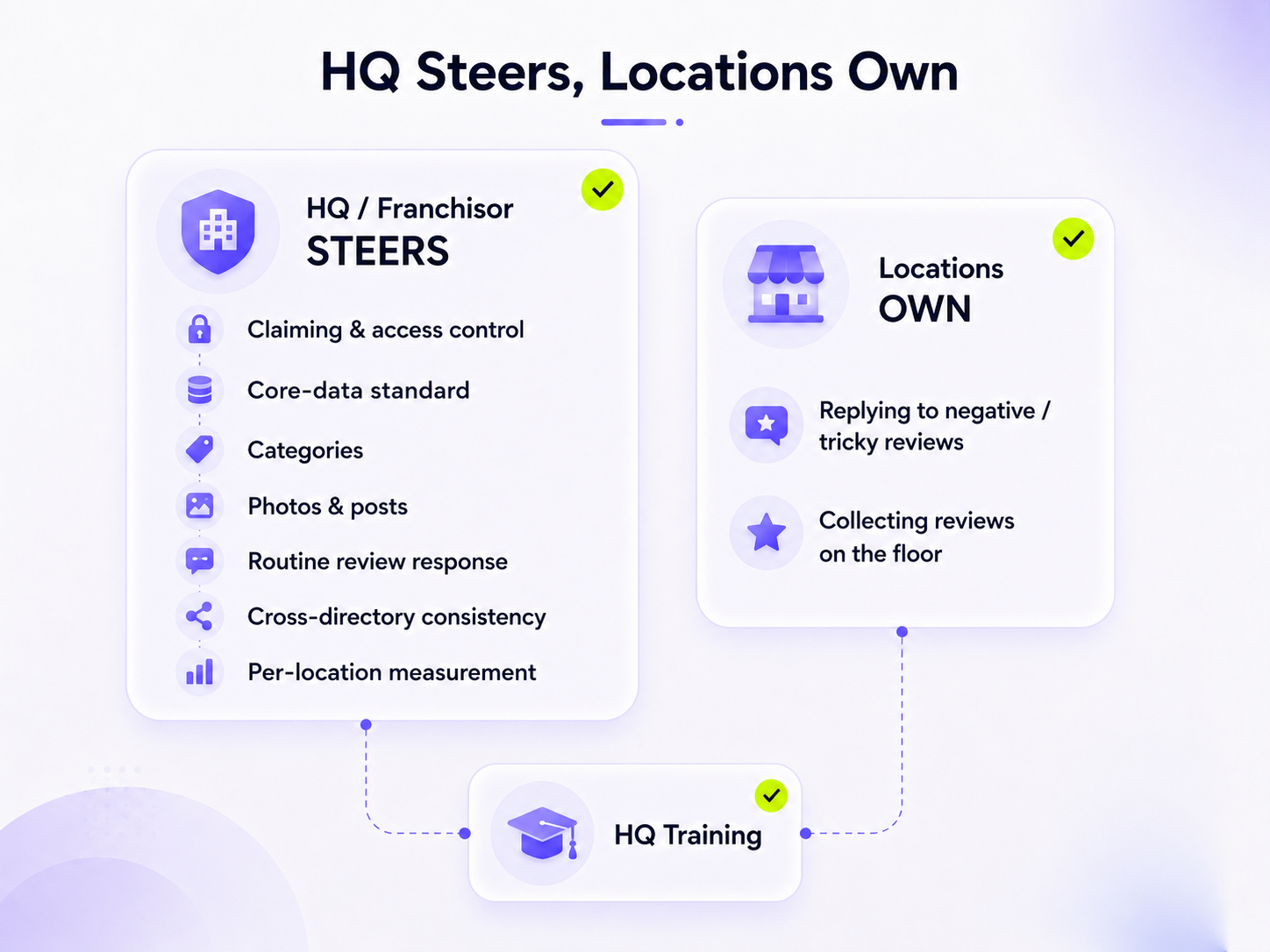
So my hard recommendation is this: Google Business Profile management, and really the whole local visibility programme, should be led and steered by headquarters or the franchisor. Only the parts that genuinely require local, on-the-ground knowledge should sit with the franchisee, branch manager or location manager.
Reviews: what headquarters owns, what the location owns
Reviews are the clearest example of that split, because they're too important to leave to chance and too local to fully centralise.
Reviews matter enormously for visibility and ranking, so the day-to-day of reading and responding to them should be taken off the locations' hands. You don't want branch managers, staff or franchisees spending their day on Google answering every review; that's a job HQ can carry centrally and consistently.
But negative and tricky reviews are different. Those should be handled by the location manager or franchisee, because only they know what actually happened in the situation the customer is describing, and only they can respond truthfully and helpfully. The role of HQ here is training: usually through the store consultants who work regionally across a group of locations, or through direct workshops with franchisees and their staff. Train them to respond well (not defensive, always helpful) and make sure they genuinely understand why it matters.
Then there's review collection, which is the other piece that truly needs the store. I'd say around 90% of the work to improve a location's digital visibility can be done digitally and remotely. But collecting reviews is one of the few things that requires people on the floor.
And here's a warning: scattering QR codes around your stores that say "review us" or "share your experience" is a poor way to collect reviews. Low efficiency, and it doesn't drive the kind of review you actually want. When a happy customer writes a review, it's far more valuable if they write it in a way that helps other customers choose your store, and helps AI choose to recommend it. That comes from training your staff (or the franchisee's staff) on how, when, and even whether to ask for a review, what to encourage the customer to mention, and whether they can add photos or videos, which help a lot.
The risk with anything you put in the hands of store owners and staff is real: most of them aren't marketers, and they won't naturally grasp the nuances. So the answer is never "just tell them to do it." The answer is a genuinely good training programme, and showing them what it means for their business, because at the end of the day it's their revenue on the line. That's what earns their effort.
Why sustained Google Business Profile beats more ad spend
If I had to give one argument for prioritising your Google Business Profile over pouring more into ads, it's this: ad spend is unsustainable.
With ads, the price you pay depends on a lot of things you can't control: the competition in your category, and whatever Google decides a click is worth today. And there's a structural risk: the moment you stop paying, you lose all the momentum and interactions that spend was buying. The same is true of social media ads. You're renting attention.
A well-maintained Google Business Profile gives you something different: a long-term, sustainable, organic flow of customers that's there whether or not you have budget this month. And if you do it properly (covering the full set of activities that local visibility requires, not just the profile) you're not stuck on a single paid channel. You become visible in the other places too: AI tools, other search engines you might not have considered, because those systems trust you. They can see your location is present everywhere with the same information, and that your customers speak well of you in reviews. It's simply a more sustainable, and over time more cost-effective, way to be found.
There's one more angle worth naming, especially for regulated categories. As an advertiser you face restrictions on what you're even allowed to promote (alcohol, medical services and medications are the obvious ones). You have far more room to work with organic content on your profile than you do inside those ad systems. For some Thai franchise categories, that flexibility alone is a strong reason to invest in the organic side.
What a proper cleanup looks like, and the uplift to expect
When a brand decides to take its local visibility seriously, the work usually starts with a cleanup. And the cleanup is more than "update the Google Business Profile." It typically includes:
- Updating and completing every Google Business Profile: accurate data, right categories, real photos.
- Merging or deleting duplicate listings wherever we find them across the network. Duplicates are a silent killer: they split your reviews and confuse both Google and customers.
- Aligning the other directories (every piece of public information about each location, on Facebook, Instagram, the data aggregators, and Bing Maps) so the whole iceberg tells one story.
Here's the honest version of what that delivers. We can't promise results: every network starts from a different place. But when a brand starts from scratch, with nothing done before, and we take the cleanup and alignment seriously, an uplift in visibility of roughly 50 to 100% within 2 to 3 months of implementation is a realistic expectation. If some groundwork was already in place, the jump is naturally smaller: there was less low-hanging fruit to capture. I've seen this hold for small chains of three or four locations, and for much larger Thai networks with hundreds of branches.
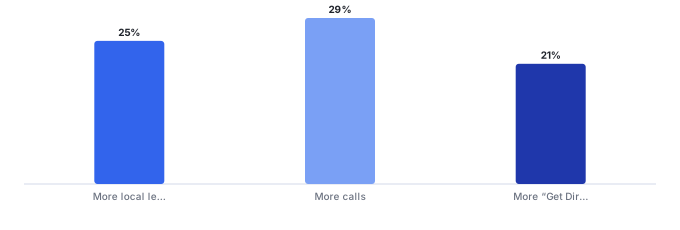
That's my own experience talking, but there's a public proof point too. OnEveryMap's published case study on the Michelin retailer network puts numbers to what active map management delivers for an auto-retail brand. Across the tyre and auto-service stores, keeping the listings actively managed and engaging with reviews drove 25% more total local leads, 29% more calls, and 21% more "Get Directions" requests (read the full write-up: Active Map Management and Review Engagement Drives 25% More Leads to Michelin Retailers). In the client's own words, from Karolina Vlasakova, E-Retail & Digital CRM Manager at Michelin East Asia & Oceania: "Working with OnEveryMap is a real pleasure. They combine professionalism and expertise to help boost our online presence and therefore generate additional traffic to our stores."
Visibility is only half of it, though. The bigger unlock for a franchisor is finally understanding how each location performs, not the network in aggregate, but branch by branch. There are ways to measure this: at OnEveryMap we can estimate the revenue driven by the interactions on each profile, read the sentiment in what customers are actually saying location by location, and see which competitors are showing up alongside you when customers search. That's the difference between managing a network by gut feel and managing it by evidence. (I'll leave the tooling there. This guide is about the discipline, not the sales pitch.)
A starting checklist for Thai multi-location brands
If you're a franchisor or multi-location operator and this guide has landed, here's a sane order to start in:
- [ ] Claim and consolidate ownership of every location's Google Business Profile under central control, with structured access, and don't leave profiles orphaned or scattered across personal accounts.
- [ ] Audit for duplicates and gaps: find the branches that don't show up, and the duplicate listings splitting your reviews.
- [ ] Standardise the core data (name, address, phone, hours, categories) into one source of truth the whole network follows.
- [ ] Extend consistency beyond Google: Facebook, Instagram, Bing, the data aggregators. Make the iceberg tell one story.
- [ ] Centralise review response, but train locations to handle negative reviews and to collect reviews well, with no lazy QR codes.
- [ ] Measure per location, not just per brand, so you know which branches need attention.
Do the first three well and you've already closed the gap that most of your competitors haven't noticed they have.
Frequently asked questions
What is Google Business Profile management?
It's the ongoing work of keeping a business's listing on Google Search and Google Maps accurate, complete, consistent and active: controlling access, keeping the core data (name, address, hours, categories) current, publishing photos and posts, and collecting and responding to reviews. For a franchise, it means doing this consistently across every location so the whole network reads as one brand.
Who should manage a franchise's Google Business Profiles, HQ or the franchisee?
Headquarters (or the franchisor) should lead and steer it, to protect a consistent brand identity across the network. Only the pieces that need genuine local knowledge (replying to negative reviews, and collecting reviews on the floor) should sit with the franchisee or branch manager, and even those should be backed by training.
Why isn't my business showing on Google Maps?
Common causes for a franchise network are unclaimed or unverified profiles, duplicate listings competing with each other, wrong or missing categories, and inconsistent information across directories that makes Google unsure which data to trust. A visibility audit will tell you which of these is affecting each branch.
What is franchise local SEO?
It's the same idea as Google Business Profile management, seen from the search side: making every branch of a multi-location brand visible and trusted for the searches customers actually make nearby. You'll also hear it called local performance optimization, local visibility optimization, or digital footprint optimization: same goal, different label.
Does Google Business Profile affect whether AI tools recommend my locations?
Yes. AI assistants recommend what they're most confident about, and that confidence is built from your Google Business Profile plus consistent information across other directories and data aggregators. If every channel says the same thing about a location, AI tools trust it enough to recommend it. If the data conflicts, they lean toward a competitor instead.
Is Google Business Profile better than paid ads for a franchise?
For sustainable, long-term discovery, yes. Ads stop working the moment you stop paying, and their cost depends on competition and pricing you can't control. A maintained profile keeps bringing in organic customers regardless of this month's budget, and makes you visible in AI tools and other search engines too. Ads still have a role, but they're rented attention, not an owned asset.
Get your free Franchise Location Visibility Audit
If you want to know where your network actually stands, which branches are invisible, where duplicates are splitting your reviews, and how consistent your data is across the directories that matter, that's exactly what our free Franchise Location Visibility Audit shows you. It's built on the same footprint data behind our 2026 franchise visibility research. Get a free franchise audit.
The strategy layer (designing a franchisee-marketing programme, getting field teams and store consultants on board, and making marketing part of a competitive franchise offer) is Marketing Bear's territory. See franchisor marketing consulting by Marketing Bear.