Get More Customers
How to Structure Your Website to Rank Higher on Google Maps
Aiyah R
The owner of a beautiful spa near Lumpini Park recently asked me, “Aiyah, why is my competitor, who opened last year, showing up first on Google Maps?” It’s a common frustration, especially when your services are superior. Often, the answer lies not just in what you offer, but how Google *sees* your business online. In this guide, we’ll uncover how a well-structured website is your secret weapon for ranking higher.
Your Website is Your Digital Shopfront. Is It Tidy?
Think of your physical business, a clinic, a spa, or a law office. You wouldn’t just throw all your equipment, products, and reception desk into one big pile in the middle of the room. You have a reception area, separate treatment rooms, and an office. It’s organized so customers know exactly where to go. Your website needs that same logical structure, not just for your human visitors, but for Google.
Google acts like a first-time visitor trying to understand what your business is about. When your website has a clean, predictable structure, Google can quickly confirm what you do, where you are, and why you’re a trustworthy choice for its users. A clear layout, homepage linking to service pages and a contact page, is a fundamental signal of a professional, well-run business. This is not a shortcut; it’s about getting the basics right to build a foundation for long-term success.
The One Page Google Cares About Most
Here’s a fact many business owners miss: the specific webpage you link to from your Google Business Profile (the listing that appears on Google Maps) is a direct and powerful ranking factor. Google examines this page with a magnifying glass to verify your business information. Sending Google to the wrong page, or to a messy one, is like giving a potential customer the wrong directions to your door.
For most single-location businesses, this link should go directly to your homepage. Your homepage should act as a central hub, clearly stating your business name, your main services, and your city or neighborhood. For example, a dental clinic in Sukhumvit should have its homepage proudly announce ‘Sukhumvit Dental Clinic,’ with clear links to pages for ‘Teeth Whitening’ and ‘Dental Implants.’ If you have multiple branches, each Google Maps listing should link to its own dedicated ‘location page’ on your website (e.g., yourwebsite.com/locations/silom-branch).
The Trap: Believing Proximity is Everything
There’s a common myth that ranking on Google Maps is simply about being the closest business to the person searching. While physical distance is definitely a factor, relying on it alone is a recipe for being outranked. Many business owners neglect their website, thinking, “I’m the only spa on this block, so I’ll always show up first.” This is a dangerous assumption.

Imagine two law firms on the same street in Ploen Chit. One has a basic, one-page website with outdated information. The other has a professional site with separate, detailed pages for each legal specialty, a page for their team, and clear contact information. Even if a user is standing closer to the first firm, Google is more likely to recommend the second one because its organized website demonstrates authority, trust, and helpfulness. According to Google’s official guidelines, a well-structured site with relevant content will almost always win against a messy one, even when proximity is a factor.
The Struggle: The Small Details That Cost Big Money
I recently started working with the owner of a fantastic boutique hotel in the Old Town. She couldn’t understand why a newer, less-reviewed hotel nearby was consistently outranking her for searches like ‘hotel near Grand Palace.’ The problem was a tiny inconsistency: her website listed the business as ‘Bangkok Heritage Hotel’, but her Google profile said ‘Bangkok Heritage Hotel Co., Ltd.’.
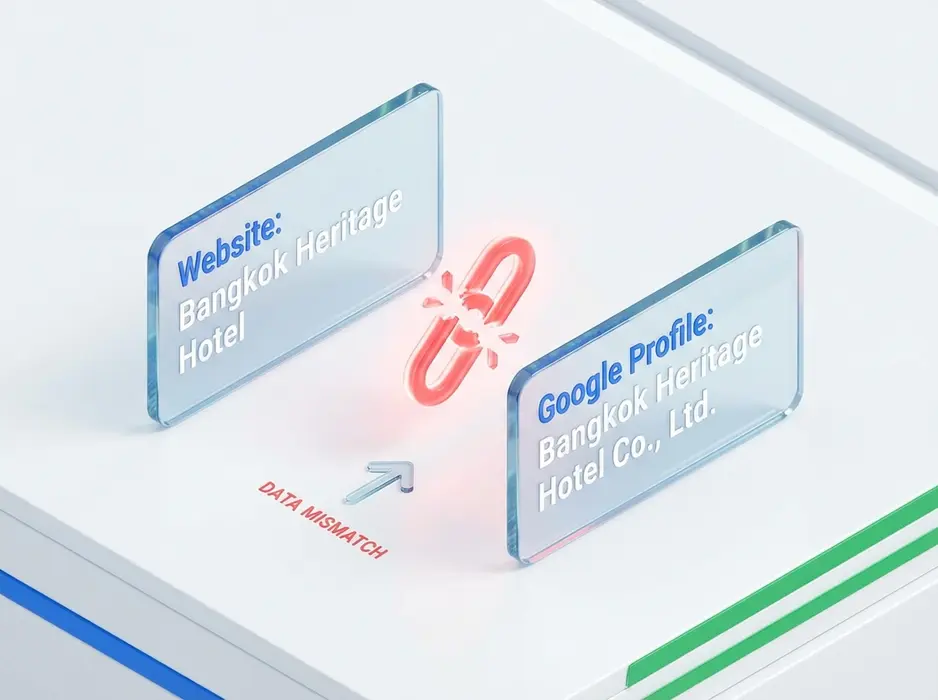
This small difference was enough to create confusion for Google. To a computer, those are two different names. Making sure your Name, Address, and Phone number (NAP) are 100% identical across your website, your Google Business Profile, and other online directories is critical. Manually finding and fixing these inconsistencies is a tedious and frustrating task. This is precisely the kind of detailed, repetitive work we designed our platform, OnEveryMap, to solve. It automatically scans your online presence, finds these exact-match errors, and helps you present a single, consistent identity to Google, ensuring you get credit for your great reputation.