Get More Customers
AI Visibility for Franchises: How to Get Your Locations Recommended by AI Tools
Jan Rohweder · Founder of OnEveryMap · CEO & Founder of Marketing Bear
Insights from Jan, founder of OnEveryMap and CEO & founder of Marketing Bear.
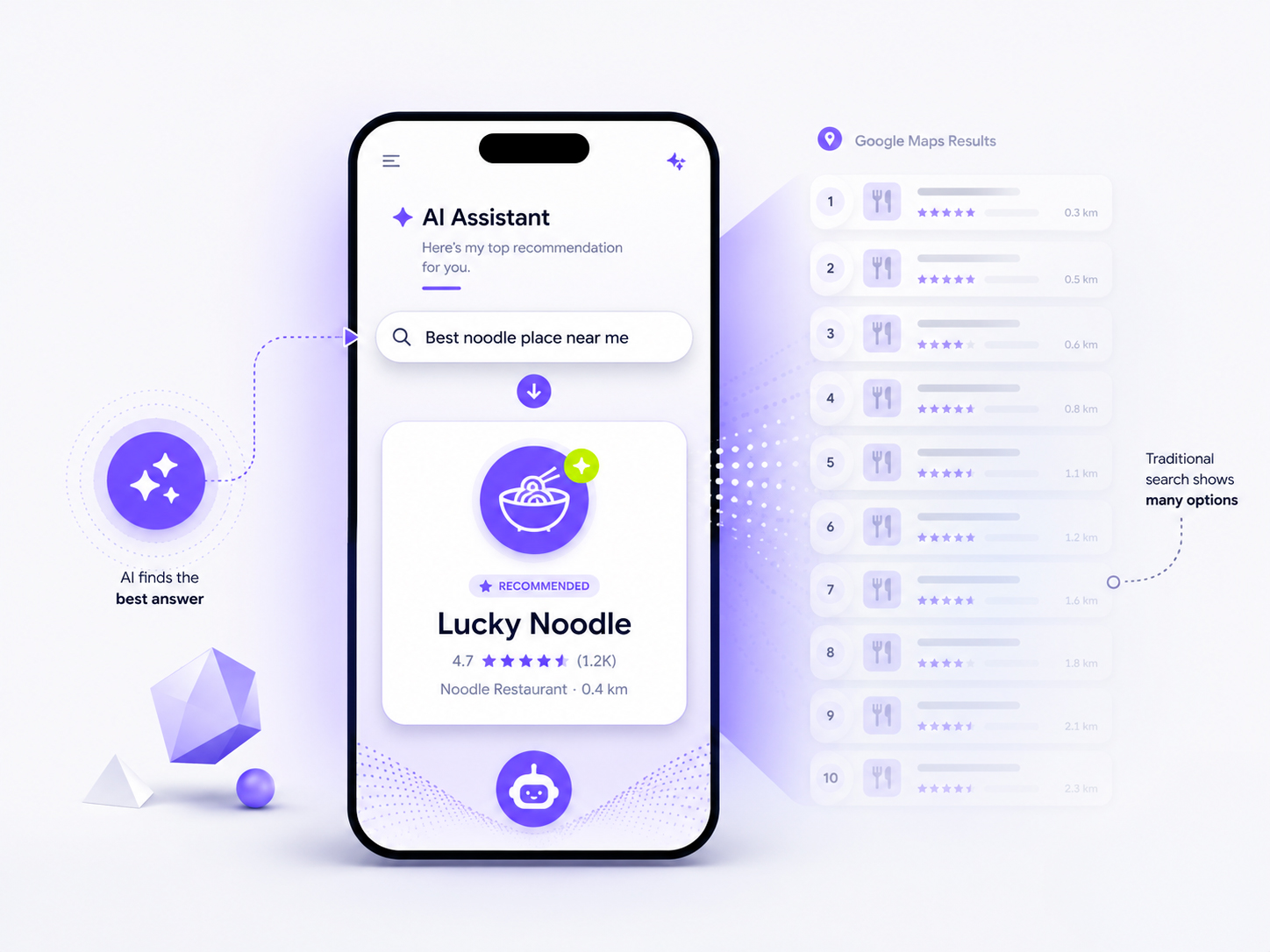
A customer with a flat tyre or a craving no longer scrolls through ten map results. More and more, they ask an assistant: "where's the best place near me for X?" Then they act on the first answer. For a franchise, that changes the question you should be asking. It is no longer only "do we rank on Google Maps?" It is "when someone asks ChatGPT, Gemini or Copilot for the nearest good option, does it name one of our branches?"
I have spent several years running the location-data and visibility work for Michelin's tyre and auto-service retail network (TyrePlus and other Michelin tyre retailers) across Thailand and Southeast Asia. When we started, AI recommendations were not a thing. What is striking now is that the exact discipline that made those stores visible on Google Maps is the same discipline that makes them visible to AI. This article is the AI-specific half of that story. For the full operations picture, see our pillar guide, Google Business Profile for Franchises.
How do AI tools decide which businesses to recommend?
The mechanism is simpler than it sounds. AI tools surface the information they are most confident about. When someone asks an assistant for, say, the best restaurant for a certain cuisine in Bangkok, it does not return everything it knows. It returns a short list of options it is most confident will give that person a good experience.
That word, confident, is the whole game. AI does not recommend the loudest brand or the biggest ad budget. It recommends what it can verify. So the job of a franchise is not to shout. It is to be the source the AI is most sure about.
Where does that confidence come from?
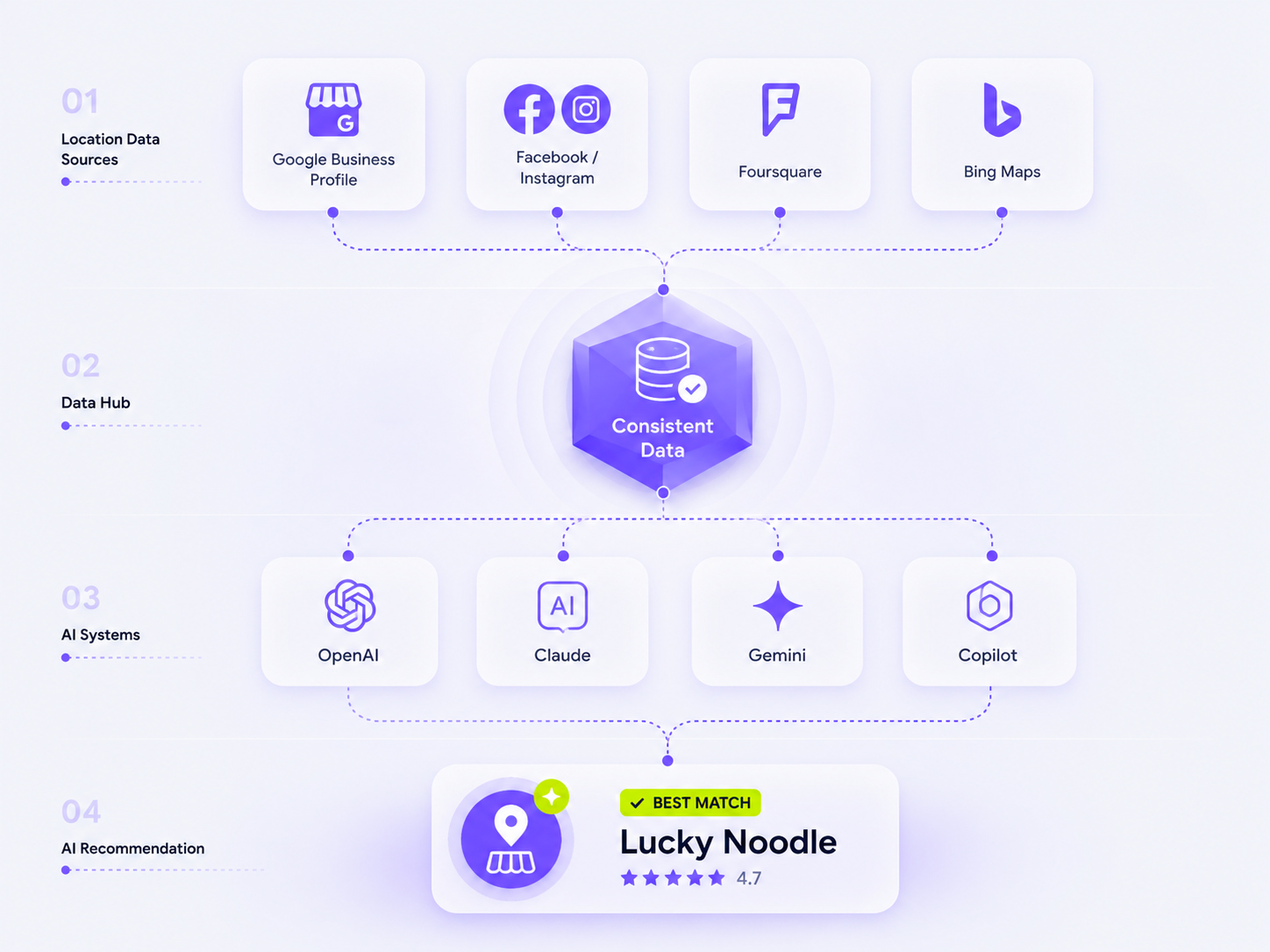
AI builds its confidence from the public data it can find about your locations, and that data is bigger than your Google Business Profile alone.
Part of it is the profile itself: what customers see on Google Maps, how they have interacted with it, and what the reviews say. But a large part sits underneath, in the other directories that feed AI systems, including the data aggregators. Foursquare is the clearest example. Almost nobody opens Foursquare as an app anymore, but it reinvented itself as a data aggregator for business locations, and that data gets sold on to the companies building AI, including OpenAI, Anthropic and Google for Gemini. Bing matters too: it verifies business data and feeds Microsoft Copilot, which more and more people meet because it auto-starts with Windows.
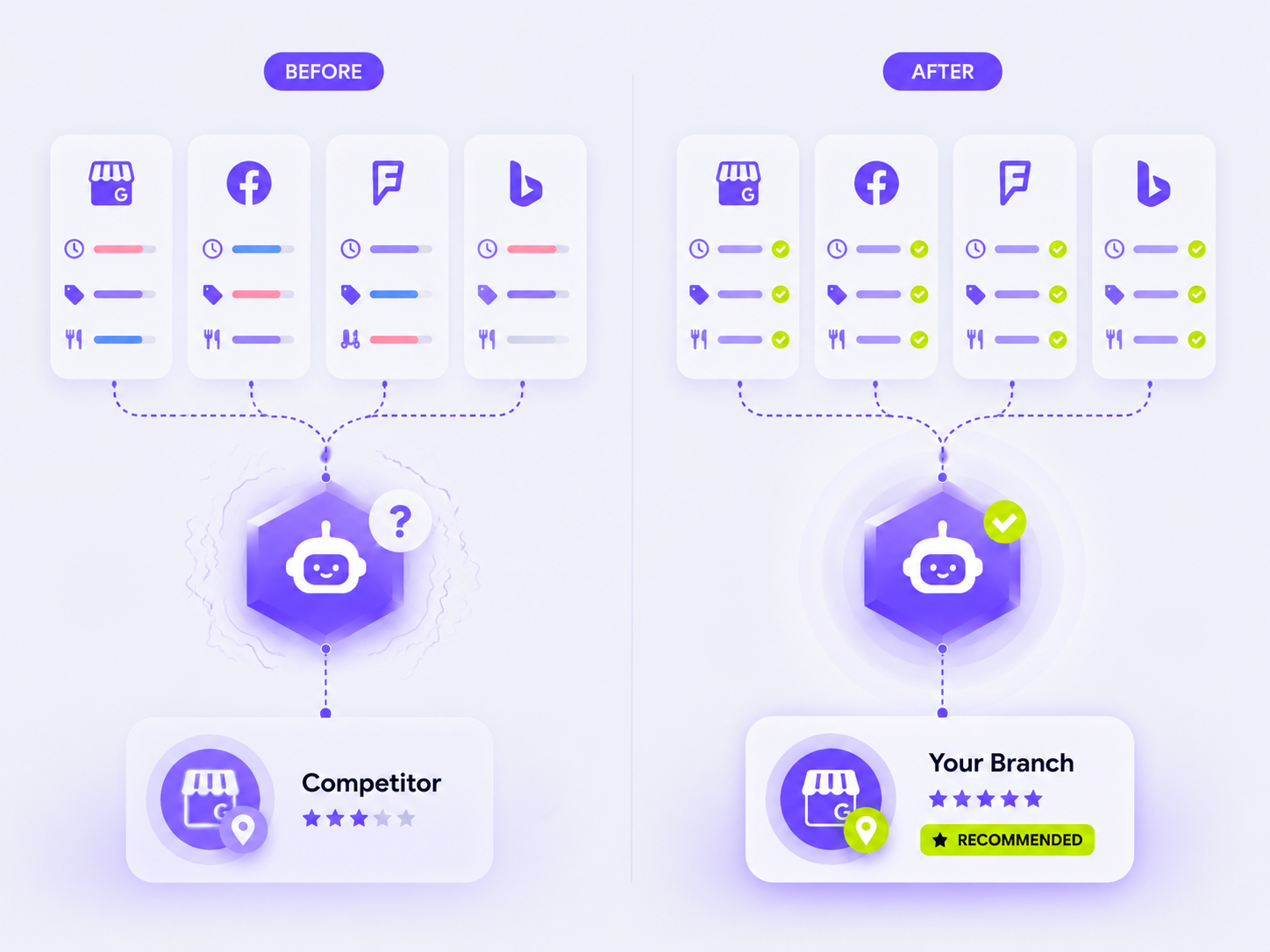
Consistency is king here. AI wants to know for certain that you do the thing you claim to do. If a customer is looking for a shop with a specific expertise, or a restaurant with a particular dish, the assistant wants to be sure that service or dish is genuinely available before it puts your name forward. It can only be sure if every channel says the same thing. When the signals agree, you get recommended; when they conflict, the AI hedges and names someone else. Even Google leans on this: when it finds the same information confirmed across other directories, that agreement lifts your visibility on Google itself.
Why franchises are especially exposed
A single café has one story to keep straight. A franchise has dozens, and if each branch is left to manage its own listings, each one tells a slightly different story: different categories, different services listed, different hours, different photos. To an AI, that inconsistency reads as uncertainty, and uncertainty is exactly what stops a recommendation. The network that should be strongest becomes the one the AI trusts least.
The harder problem is when a branch is not really present at all. In our own 2026 research into Thai franchise brands, the gap was visible in the data: 124 brands were effectively invisible when we checked their Google Maps footprint, and 2,151 individual locations had no website link attached to their profile (measured July 2026). A location an AI cannot find, or cannot connect to a website that confirms what it offers, simply is not in the running when the assistant answers.

Reviews are evidence AI reads
Reviews are not just social proof for humans. They are evidence an AI reads to confirm what your locations actually do well. A review that names the specific dish, service or outcome helps an assistant verify a claim it cannot otherwise check, so "great somtam and fast service at the Rama IX branch" is worth far more to your AI visibility than five that just say "good."
This is also why scattering QR codes that say "review us" around your stores is such a weak tactic. It is low efficiency, and it does not steer customers toward describing the things you want to be found for. Far better to train your staff on how, when and even whether to ask, and on what to encourage the customer to mention. Photos and videos help too.
On who does what: headquarters or the franchisor should lead and steer the visibility work across the whole network, because that is the only way to keep every branch consistent. The parts that need genuine local knowledge (replying to negative or tricky reviews, and collecting reviews on the floor) belong with the branch, backed by good training. I go deeper on that split in the pillar guide.
How to become the answer AI gives
Practically, becoming the confident, question-shaped source comes down to four moves:
- Be present everywhere AI reads, not just Google. Claim and complete every location on Google Business Profile, then mirror the same information to Facebook, Instagram, the data aggregators and Bing. Google is the tip of the iceberg; the mass underneath is what earns AI's confidence.
- Make every branch say the same thing. One source of truth for name, address, phone, hours, categories and services, identical across the network. Consistency is the single biggest lever.
- Be specific about what you offer. Fill in the structured fields (services, attributes, menu items, categories) so an AI can verify a claim rather than guess. If you want to be recommended for a thing, that thing has to be in the data, not just implied.
- Collect reviews that describe those things. Point happy customers toward the specific service or dish, so your reviews reinforce exactly what you want to be the answer for.
How do you measure AI visibility?
You cannot manage what you do not measure, and AI visibility is measurable. In practice it means three things. First, ask the assistants the questions your customers ask ("best X near Y") and check whether your branches actually appear, and how you are described. Second, track your presence and consistency across the directories that feed AI, so you can see where the story breaks. Third, watch reviews and sentiment location by location, because that is the evidence AI is reading in real time.
This is the work OnEveryMap was built for: keeping a location's information consistent across 65+ networks so the AI systems downstream stay confident. But you do not need our platform to start. You need to know where you stand today, branch by branch.
Frequently asked questions
Will ChatGPT recommend my franchise's branches?
Only if it is confident about them. Assistants recommend businesses whose information they can verify across the sources they read. If a branch is present, consistent and specific about what it offers, it can be recommended. If its data is missing or conflicting, the assistant names a competitor it is surer about.
How do I get my business recommended by AI tools?
Be present on the platforms that feed AI (Google Business Profile, Facebook, Instagram, the data aggregators and Bing), keep every branch's information identical, spell out your services in the structured fields, and collect reviews that describe those services.
Does my Google Business Profile affect AI recommendations?
Yes, but it is only the start. The profile is your most visible signal, and AI leans on it heavily, but it cross-checks against other directories and data aggregators. When they agree, confidence rises; when they conflict, it drops. Google itself works the same way.
How do I check my AI visibility?
Ask the assistants the questions your customers ask and see whether you appear, audit how consistent your location data is across the feeding directories, and monitor reviews and sentiment per branch. A visibility audit does this systematically.
Run a free AI visibility check
If you want to know whether AI tools can confidently recommend your branches, our free Franchise Location Visibility Audit now includes an AI visibility check. It looks across up to 14 platforms and shows you where your data conflicts, where branches go missing, and where an AI would lose confidence in your network. It is built on the same footprint data behind our 2026 franchise visibility research. Get your free franchise audit.
The strategy layer (designing a franchisee-marketing programme and making marketing part of a competitive franchise offer) is Marketing Bear's territory. See franchisor marketing consulting by Marketing Bear.