Get More Customers
Franchise Review Management: Who Owns Reviews, HQ or the Branch?
Jan Rohweder · Founder of OnEveryMap · CEO & Founder of Marketing Bear
Insights from Jan, founder of OnEveryMap and CEO & founder of Marketing Bear.
Ask a franchisor who should handle Google reviews and you usually get one of two answers: "the branches do it," or "head office does it." Both are half right. After years running the location-data and review work for Michelin's tyre and auto-service retail network (TyrePlus and other Michelin tyre retailers) across Thailand and Southeast Asia, I've come to see reviews as the clearest example of a job that has to be split: too important to leave to chance, too local to fully centralise.
This is a practical guide to franchise review management: who owns what, how fast to respond, and how to collect the reviews that lift visibility. It's a companion to our complete guide to Google Business Profile for franchises.
What is franchise reputation management?
Franchise reputation management is the ongoing discipline of collecting, monitoring and responding to customer reviews across every location of a multi-location brand, consistently, so the whole network reads as one trusted brand rather than 50 loosely related shops.
For a single café it's a light task. For a franchise with 40, 80 or 400 branches it's an operations system with two moving parts: responding to the reviews that come in, and collecting new ones from happy customers. Get it right and reviews become one of your strongest, cheapest engines of local discovery. Ignore it and it quietly costs you business you never see leaving.
Why reviews decide who wins the local pack, and what AI recommends
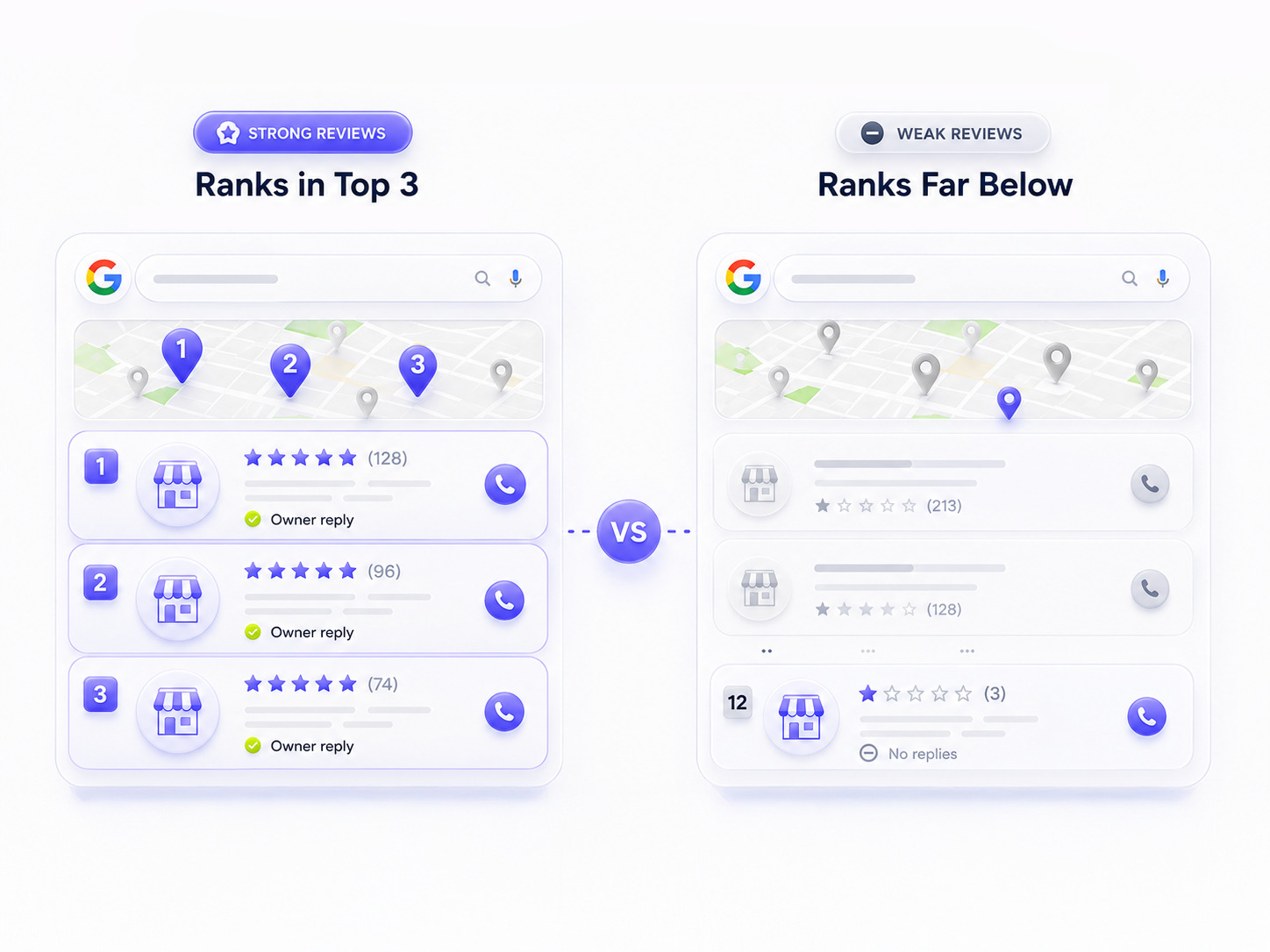
Reviews are not a vanity metric. Volume, recency, the rating itself and whether you actually reply all feed into which branch shows up in the local pack (the map results with the pins) when a customer searches nearby, and which one gets skipped.
There's a newer reason they matter even more now. AI tools surface the businesses they are most confident about, and a big part of that confidence comes from what your customers say and how you engage. When someone asks an assistant for the best nearby option, the AI leans toward locations where the reviews are consistent, recent and genuinely positive. Silent, review-thin profiles give it a reason to recommend a competitor instead.
And reviews only work if the location is findable at all. In our own 2026 research into Thai franchise brands, 124 were effectively invisible when we checked their Google Maps footprint (measured July 2026). A branch nobody can find can never accrue the reviews that would have made it rank.
I've watched this play out at scale. OnEveryMap's published case study on the Michelin retailer network (its tyre and auto-service stores) is exactly about this: active map management and review engagement drove 25% more total local leads, 29% more calls, and 21% more "Get Directions" requests across the network (read the write-up). Engaging with reviews is not housekeeping. It moves the numbers that matter.
The ownership split: what HQ owns, what the branch owns
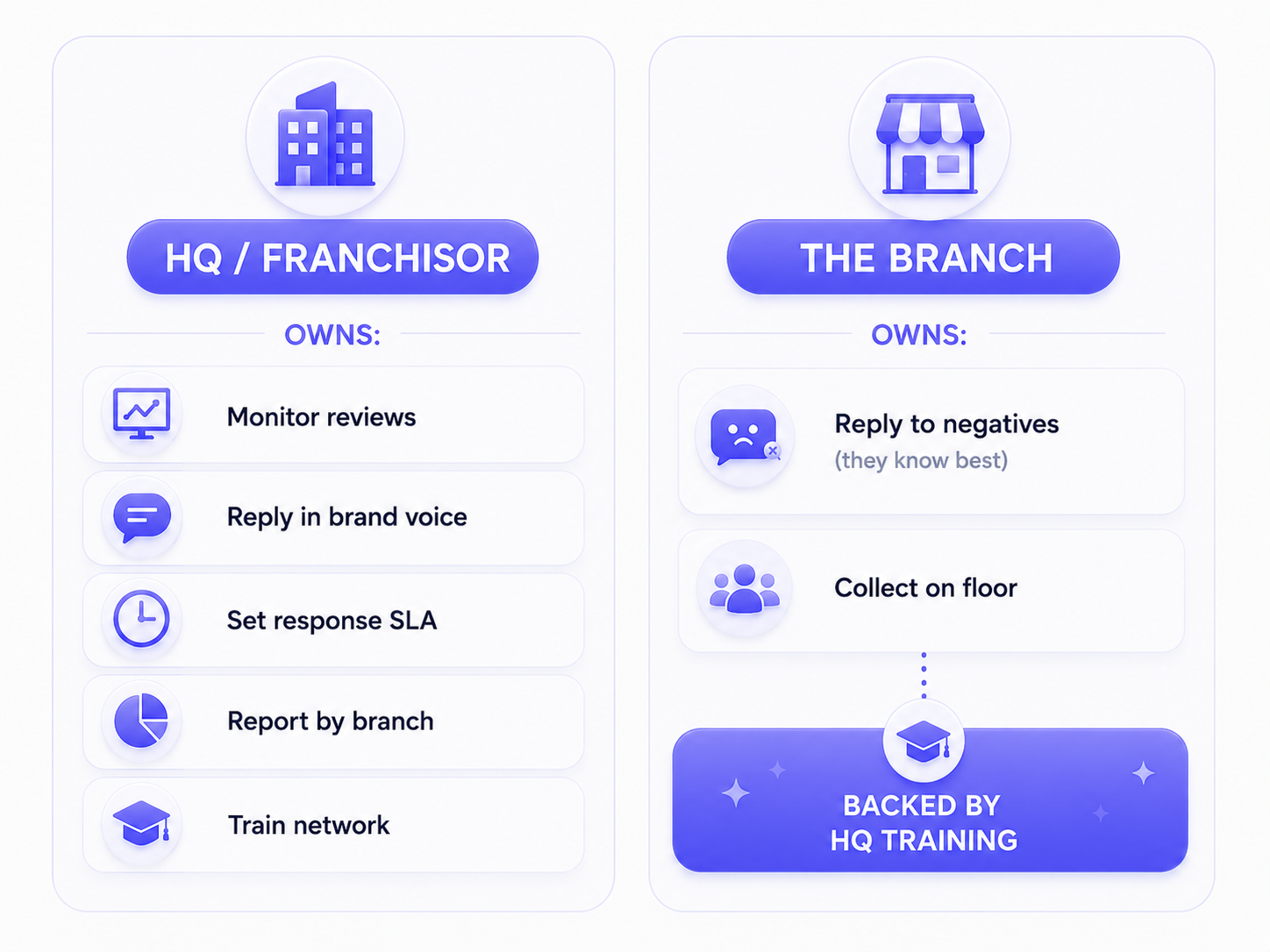
Here is the split I recommend to every multi-location brand.
Headquarters owns the routine. The day-to-day of reading reviews and replying to the ordinary ones (the 5-star "great service," the 4-star "a bit busy at lunch") should be taken off the locations' hands entirely. You don't want branch managers, staff or franchisees spending their day on Google answering every review. HQ can carry that centrally, in one consistent brand voice, so every reply reads like the same company, and so it actually gets done instead of depending on a busy store remembering.
The branch owns the tricky ones. Negative and complicated reviews belong to the location manager or franchisee, because only they know what actually happened in the situation the customer describes. A head-office team replying blind to an angry review about a specific afternoon, a specific order, a specific member of staff, can only guess, and guessing shows. The branch can respond truthfully and put it right.
HQ's job on those tricky reviews is not to write them: it's training. Usually that runs through the store consultants who work regionally across a group of locations, or through direct workshops with franchisees and their staff. Train people to respond well: never defensive, always helpful, always fixing the real problem. Anything you hand to store staff carries a risk, because most of them aren't marketers and won't naturally grasp the nuances. A genuinely good training programme is what closes that gap.
Review velocity and response SLAs: the two dials that run the system
Two simple dials keep this system honest.
The first is a response SLA: a target for how quickly reviews get answered. A negative review left sitting for two weeks tells every future customer that nobody is home. A sensible starting target is to reply within one business day, and to flag negatives to the branch immediately so they can respond while the detail is fresh. (Treat that as a target to set, tuned to your team's capacity, not a guarantee.)
The second is review velocity: a steady, ongoing stream of recent reviews rather than a one-off burst. A location that collected 40 reviews two years ago and nothing since looks stale to both customers and Google. One earning a handful of genuine reviews every week looks alive and trusted. Velocity is why collection can't be a one-time campaign; it has to be a habit built into how the store operates.
Collecting reviews needs the store, and good training
Roughly 90% of the work to improve a location's digital visibility can be done digitally and remotely from HQ. Collecting reviews is one of the few things that genuinely needs people on the floor, because it happens in the moment, with a customer who just had a good experience.
That's exactly why it needs training, not just a poster. The questions that matter are how to ask, when to ask, and even whether to ask a given customer at all. A rushed or unhappy customer is the wrong person to approach. The regular who just told your staff "this is the best branch I've been to" is the right one, at the right moment. Teaching staff to read that difference is most of the battle.
Why "review us" QR codes on their own are an anti-pattern
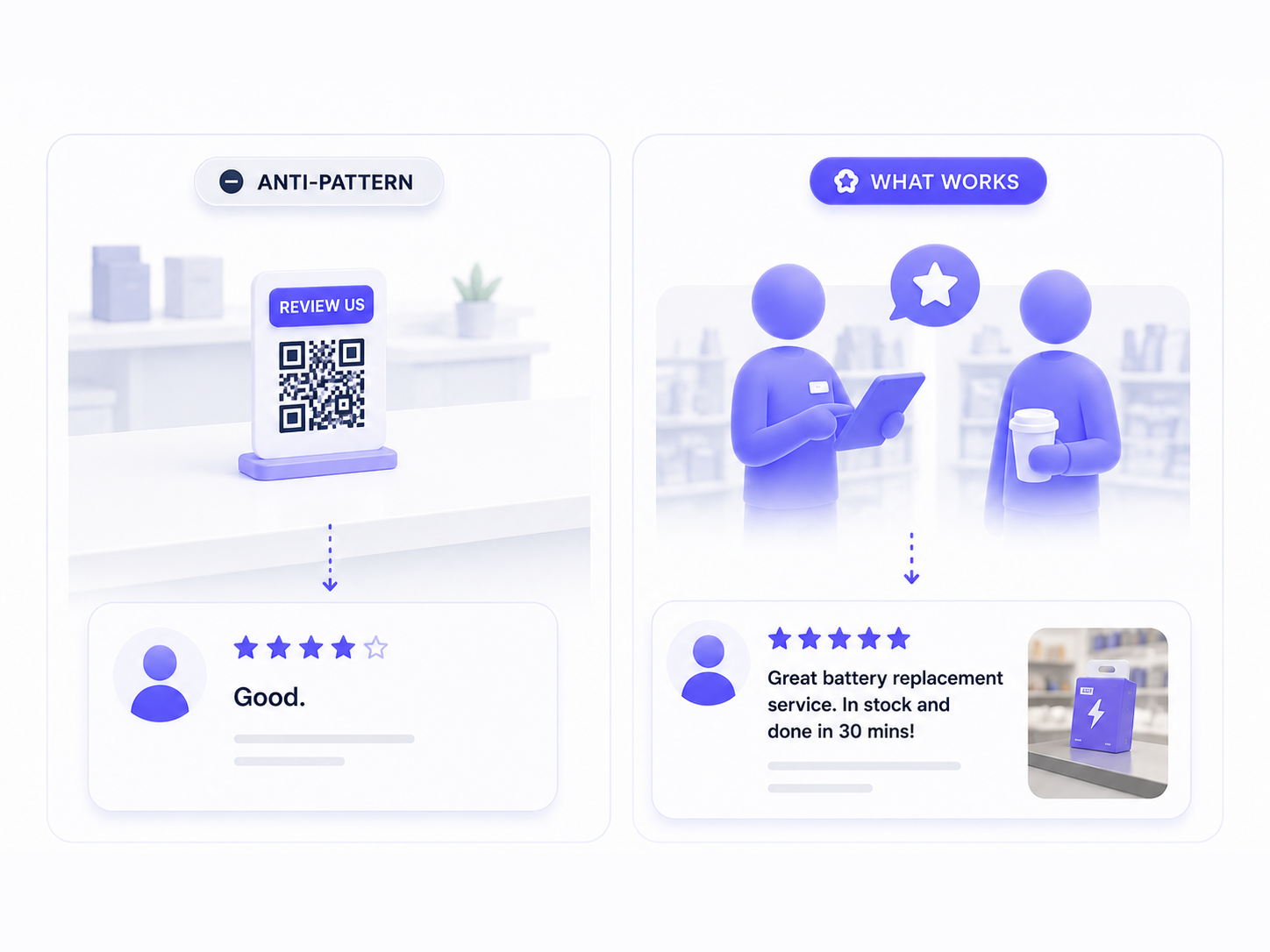
Here's a warning I give often: scattering QR codes around your stores that say "review us" or "share your experience" is a poor way to collect reviews on its own. Low efficiency, and worse, it doesn't drive the kind of review you actually want.
When a happy customer writes a review, it's far more valuable if they write it in a way that helps other customers choose your store, and helps AI choose to recommend it. "Great" tells no one anything. "Fast tyre change, they had my size in stock, and the waiting area was clean" tells a future customer, and an AI assistant, something concrete. That comes from a member of staff trained to gently prompt: what did you come in for, what stood out, and would you mind mentioning it? Inviting a photo or short video helps even more.
So the QR code is fine as the final step, the easy link that removes friction once someone has decided to write. It's a terrible strategy on its own. The strategy is trained staff asking the right happy customers, the right way, at the right time.
None of this works if it feels like admin dumped on the stores. Show franchisees and branch staff what better reviews do for their location's ranking and their revenue. At the end of the day it's their business on the line, and that's what earns the effort.
Frequently asked questions
What is franchise reputation management?
The ongoing work of collecting, monitoring and responding to customer reviews across every location of a multi-location brand, consistently, so the whole network reads as one trusted brand. It has two halves: responding to reviews as they come in, and collecting new ones from happy customers.
Who should respond to Google reviews, HQ or the franchisee?
Split it. Headquarters should monitor everything and reply to routine reviews centrally, in one brand voice. Negative and tricky reviews should be handled by the branch manager or franchisee, because only they know what actually happened, backed by training from HQ on how to respond well.
How fast should a franchise respond to reviews?
Set a response SLA and hold the network to it. Replying within about one business day is a sensible target, with negatives flagged to the branch immediately so they can respond while the detail is fresh. Treat it as a target tuned to your team's capacity, not a promise.
Do Google reviews affect local ranking?
Yes. Review volume, recency, rating and whether you reply all feed into which branch appears in the local pack for a nearby search, and increasingly into which locations AI tools feel confident enough to recommend.
Should franchises use QR codes to collect reviews?
Only as the final, frictionless step once a customer has decided to write. On their own, "review us" QR codes are low-efficiency and produce thin, unhelpful reviews. What works is trained staff asking the right happy customers, the right way, and inviting a photo or video.
Get your free Franchise Location Visibility Audit
Reviews are one layer of a bigger picture: how findable, consistent and trusted every branch of your network is. Our free Franchise Location Visibility Audit shows you where each location stands (across up to 14 platforms), including which branches are hard to find and where your review picture is quietly costing you leads. Get your free franchise audit.
The strategy layer (designing a franchisee-marketing programme, getting field teams and store consultants on board, and making marketing part of a competitive franchise offer) is Marketing Bear's territory. See franchisor marketing consulting by Marketing Bear.